Birmingham Water Damage Restoration › Macomb County
Water Damage Restoration Reaching Macomb County
Fast water extraction and structural drying for a burst pipe, basement flood or storm intrusion. Birmingham Water Damage Restoration dispatches into Macomb County from the Local Headquarters in Birmingham, Oakland County -- the same crew, the same phone number, with the honest limits on this page stated up front rather than left for a caller to discover later.
Macomb County is reached by dispatch, not from a second address. A call still starts a crew moving the same hour; what this page will not do is print a minute count for a county with no staffed office in it yet.
A written guarantee sits behind the work, promising a re-visit over your money back.
The Work in Four Movements
Your Call
Give us the address and the basics of what happened.
Our Arrival
A technician reaches the home and locates the source of the water.
The Record
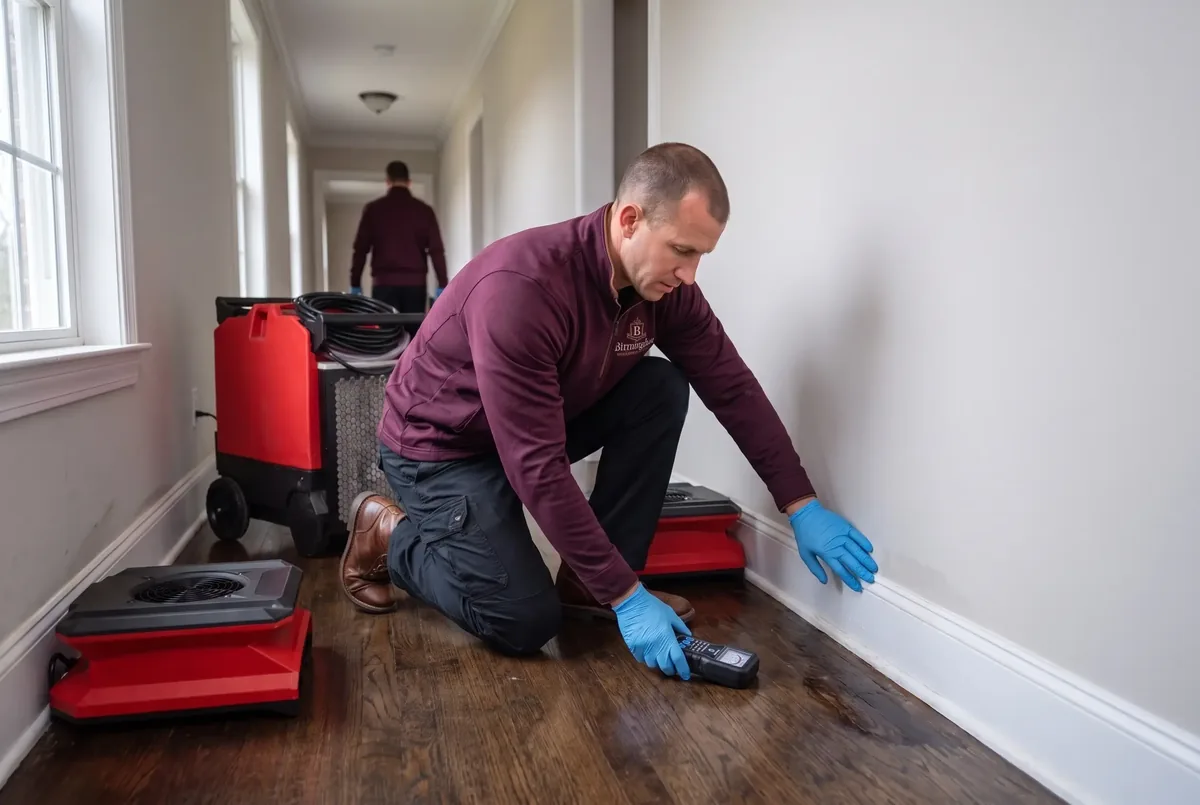
Photos and moisture readings happen before any tear-out.
The Restoration
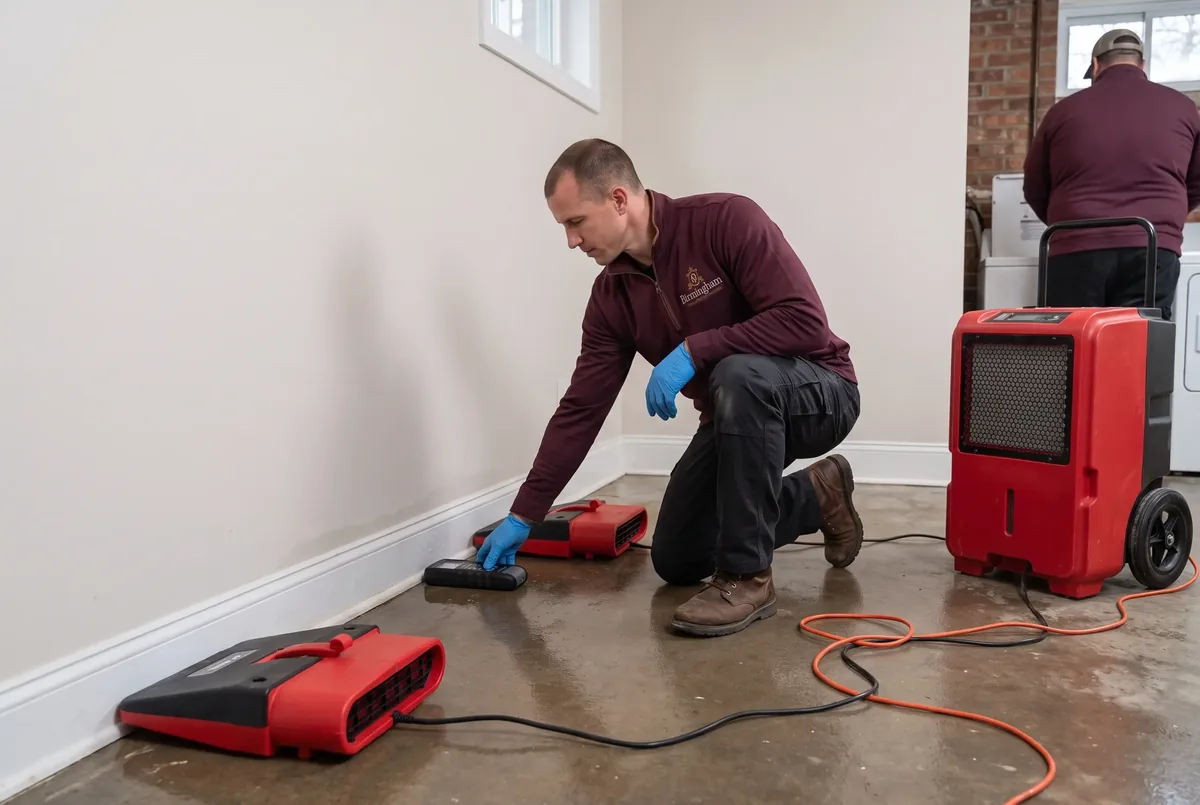
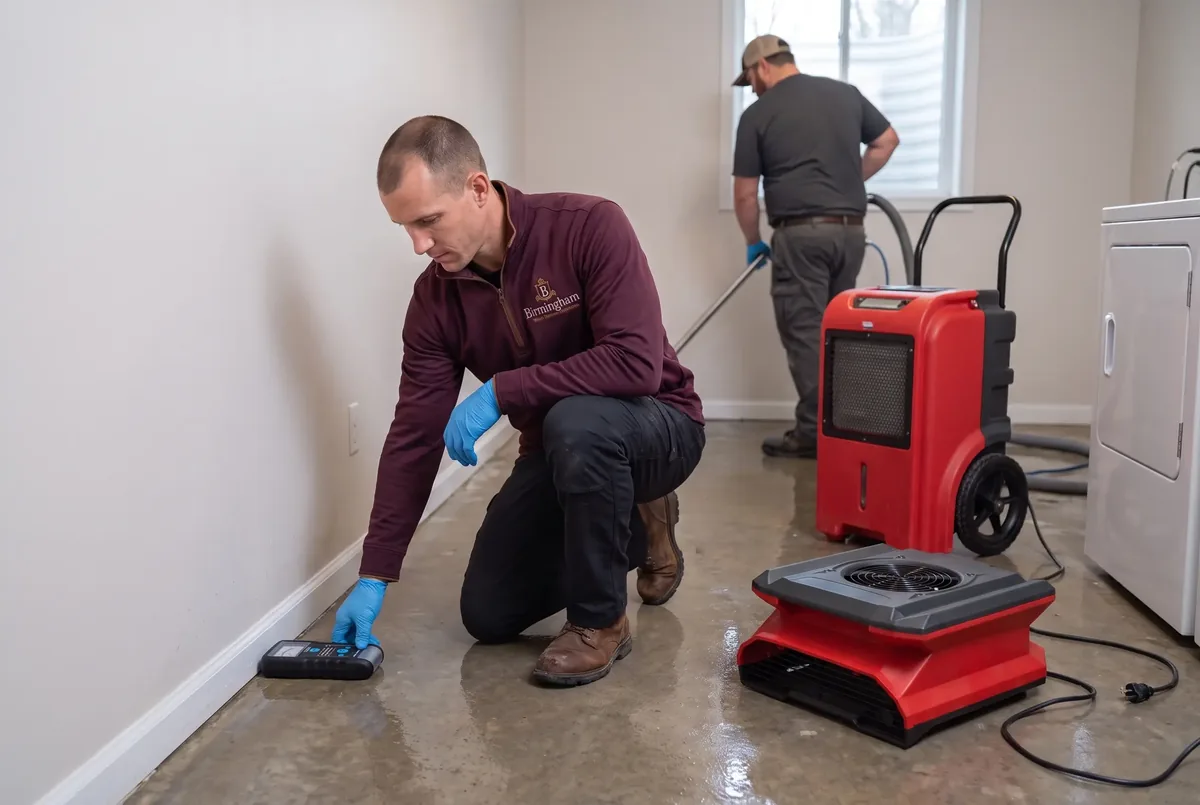
Standing water and ruined material are removed, then drying equipment runs to a dry reading.
Why Macomb County Homeowners Call Before a Local Office Exists
- No staffed address inside Macomb County today -- so no drive-time figure for this county, and no county-specific minute count. That is the one limit this page is built around.
- The same 24/7 line answers a call from Macomb County as from anywhere else this company serves; dispatch, not distance, decides who picks up.
- A crew that reaches Macomb County logs the same dated photographs and moisture readings used on every job, so the file an adjuster sees does not read any thinner for being dispatched.
A county this size rarely fails the same way twice: a pipe failure, a storm-overwhelmed sump pump, and a slow seep through an aging foundation wall are three different calls with three different first answers, and the record on this page states only what is actually known about Macomb County specifically, never a sentence copied over from a town somewhere else.
A landlord or a property manager with more than one address inside Macomb County dials the same 24/7 line a single homeowner does, and the crew that answers asks the same first question of either caller: where did the water start. Nothing about who owns the building changes that answer, or the documentation that follows it.
Winter adds its own version of the same emergency: a supply line that freezes, then splits, behaves differently from a summer sump failure, but the record a crew keeps afterward -- photographs, a moisture reading, the hour the call came in -- gets built the same way regardless of season or cause, dispatched crew or not.
A real-estate closing or a pre-sale inspection in Macomb County is a reasonable reason to call too, not just an active flood. A second opinion on an old stain or a damp crawl space, before a deal closes, gets the same straight answer whether or not it turns into a job afterward.
What We Restore, Macomb County-Wide
A water call and a mold call are rarely two separate emergencies; the second one usually grows out of the first. Left wet for a few days, a basement starts smelling before it starts visibly growing, and the window for drying alone to finish the job closes earlier than most homeowners expect, faster still in the older housing found in parts of Macomb County.
| Find the source | A pipe, a pump or a slow seep each point to a different next call. |
| Extract and dry | Air movers and dehumidifiers run on a schedule, checked by reading, not by guess. |
| Contain and remove | When mold has already started, containment comes before removal, not after. |
| Document and clear | A written clearance report closes the file, for the homeowner and for the insurer. |
Mold removal does not mean opening every wall on sight. Containment goes up around the affected area first, air inside that containment runs negative so spores do not travel to the rest of the house, and only then does removal start -- a sequence that protects the rooms that were never wet in the first place as much as it treats the one that was.
Documents, photographs and small electronics are their own category, treated differently from carpet or drywall: a water-damaged paper record or a family photograph often cannot be replaced at any price, which is the reason specialized drying for those items gets handled on its own track rather than folded into the general structural dry-out.
Water Damage Restoration
Fast water extraction and structural drying for a burst pipe, basement flood or storm intrusion.
Mold Remediation
Mold removal with full containment after a water loss, plus a written clearance report.
Macomb County, on the Record
Each row below carries its own source; a figure with nothing behind it does not get a row. Macomb County's population, income spread and housing age set the backdrop for everything else on this page -- older money does not always mean older plumbing, and newer subdivisions are not immune to a storm that overwhelms a sump pump regardless of the year a house was built.
| Field | What the record says | Source |
|---|---|---|
| Population | The Census Bureau's 2024 five-year estimate counts 879,853 people living in Macomb County. | U.S. Census Bureau ACS 2024 5-year estimates |
| Housing age | 373,413 housing units stand countywide, and 41.4% of them predate 1970 -- a figure that tracks directly with plumbing and drainage failures. | U.S. Census Bureau ACS 2024 5-year estimates (B25034) |
| Sewer and drain notice | A sewage or storm backup here needs written notice to the Macomb County Public Works Office inside 45 days, or state law blocks recovery; its hotline runs 24 hours at (877) 679-4337. | Macomb County Public Works Commissioner |
| Income varies block by block | The lowest-income ZIPs sit in Mount Clemens and Warren, near $52,000 to $54,000; the highest, over $126,000, sit in the Macomb/Ray Township growth corridor. | U.S. Census Bureau ACS 2024 5-year estimates (B19013 |
The lowest-income ZIPs sit in Mount Clemens and Warren, near $52,000 to $54,000; the highest, over $126,000, sit in the Macomb/Ray Township growth corridor. (U.S. Census Bureau ACS 2024 5-year estimates (B19013)
Reading a spread like that one street at a time is the actual job: a county-wide average tells a planner something useful and tells a homeowner almost nothing about the house they are standing in. The number that matters on the night of a loss is the one for that address, not the county median, which is why the table below moves from the county level down to named towns rather than stopping here.
Macomb County, Town by Town
Birmingham Water Damage Restoration does not claim a separate crew stationed in each of these towns; this table states what the public record says about flooding, drainage and housing age in each one, for a homeowner who wants to check a fact before calling rather than take a sales page's word for it. Six towns appear below because each one has a dated event, a named flood source, or a housing-age figure on file -- a town without one of those is left off rather than filled in with a guess.
| Town | What the record says | Source |
|---|---|---|
| Sterling Heights | Sterling Heights names four flood sources on its own records -- the Clinton River, Red Run Drain, Plumbrook Drain and Beaver Creek. FEMA's Community Rating System grades Sterling Heights a Class 7, worth a 15% cut on flood-insurance premiums there. | City of Sterling Heights City of Sterling Heights |
| Warren | An August 11, 2014 storm put 6 feet of water inside Warren's City Hall, forced an emergency declaration, and sent the Clinton River gauge at Mount Clemens past 16 feet. Warren's own housing stock runs older than its neighbors': 56,962 units with a 1964 median build year. | CBS News Detroit Census Reporter (ACS 2024 1-year) |
| St. Clair Shores | An August 16, 2016 rain of under two inches was still enough to flood basements in St. Clair Shores, where the combined sewer cannot push excess water straight into Lake St. Clair. The Chapaton Retention Treatment Basin, near Nine Mile Road, took a $29 million upgrade that pushed its capacity from 3 million to 17 million gallons. | FOX 2 Detroit Macomb County Public Works |
| Clinton Township | Clinton Township splits drainage three ways: county drains go to the Public Works Commissioner, local storm lines go to the township itself, and road drains belong to the county road department. Clinton Township counts 49,724 housing units with a 1980 median build year, and most of them -- 61.8% -- are owner-occupied. | Clinton Township Census Reporter (ACS 2024 1-year) |
| Mount Clemens | A canal finished in 1951 still diverts the Clinton River at Mount Clemens toward Lake St. Clair, though the USGS itself says it will not stop every future flood. | USGS Hydrologic Atlas HA-59 |
| Fraser | Fraser's stormwater runs to catch basins and county drains named Harrington and Sweeny before reaching the Clinton River at Mount Clemens; the city recommends checking a private sewer lateral every five to ten years. | City of Fraser |
A sewer or drain responsibility runs through a different office depending on where the water started: a city main runs through that city's own public works department, a county drain runs through Macomb County Public Works Office, and the stretch of pipe between the house and the street is almost always the homeowner's own responsibility. Knowing which one applies before a claim is filed is part of what a dated, photographed record protects.
Two neighboring towns on this list can carry very different housing-age numbers, and that difference is not trivia: a block built in the 1960s is statistically more likely to still be running original cast-iron drain lines or a foundation drainage system installed to a much older code, both of which fail in ways a newer subdivision simply does not have to worry about yet.
A homeowner outside these six named towns, elsewhere in Macomb County, can still call: the line above covers the whole county by phone today, even where this page has not yet found a dated, sourced fact worth publishing for that specific address. This table grows as more of the record gets checked, not as a matter of which town is easiest to write about.
Spring and late summer bring the two calls this table's record points toward most directly: a spring thaw on top of already-saturated ground overloads a drain system built for an ordinary rain, and a late-summer storm can drop more water in an hour than a sump pump sized for a normal week ever expects to move. Neither season is rare here; both show up in the dated events above.
See the Oakland County towns this company's own crew works most often.
Michigan's Claim Clock, and the County's Own Clock
A policy and a county drain are governed by two different bodies of rules, and a homeowner who tracks only one of them can be perfectly on time for the wrong clock. Read the insurance claims guide for the complete list; the lines that matter most right after a fresh loss sit in the table below.
| Rule | What it requires | Source |
|---|---|---|
| Proof-of-loss notice | Under MCL 500.2006, a Michigan insurer that has not already paid your claim must send written word of what proof of loss it needs within 30 days of you filing it. | Michigan Compiled Laws 500.2006 |
| Payment and interest | From the date your insurer has everything it asked for, the same statute gives it 60 days to issue payment, and a payment that runs late without a genuine dispute accrues interest at 12% a year. | Michigan Compiled Laws 500.2006 |
| Appraisal on a disputed amount | MCL 500.2833 gives both you and your insurer the right to force an appraisal of a disputed amount: each side writes in, each side picks an appraiser within 20 days, and those two appraisers pick an umpire to settle the figure. | Michigan Compiled Laws 500.2833 |
| Sewer-backup notice to a government agency | MCL 691.1419 sets a 45-day clock: that is how long you have, counted from the day you discover a sewer or drain backup, to give the responsible government agency written notice if you intend to bring a claim. | Michigan Compiled Laws 691.1419 |
Macomb County Public Works Office runs the other clock: a written notice within 45 days of discovering a backup, through its hotline (877) 679-4337. That notice has nothing to do with a homeowner's own insurance policy -- it is the step that preserves a claim against the government agency responsible for the drain itself, and it is owed whether or not an insurance claim ever gets filed at all.
Where the two rules intersect is documentation. A photograph taken the day water entered a house, timestamped and matched to a moisture reading, supports both processes at once: the insurer wants to see when the loss happened and how bad it was, and the county wants proof that notice followed discovery promptly. A crew that treats the camera as part of the job, not an afterthought, is building one record that answers to two different offices.
A homeowner rarely knows, standing in a wet basement at midnight, whether the water came from a sump pump, a sewer, or a crack in the foundation -- and the clock above does not wait for that question to be answered before it starts running. That is the practical argument for calling immediately rather than waiting to diagnose the cause alone: a crew on site the same night is what turns "I think it might be the sewer" into a dated, specific record either notice depends on.
None of this is legal advice, and this page does not pretend otherwise. A homeowner with a disputed claim or a denied one is better served by the full insurance claims guide and, where the dollar amount justifies it, a conversation with an attorney -- this page states the deadlines, not the strategy for fighting a denial, and it would rather send a homeowner to the right specialist than pretend to be one itself.
Reviews, Honestly Scoped
Birmingham Water Damage Restoration has no Google Business Profile tied to Macomb County yet; any review count shown elsewhere on this site belongs to the Birmingham listing only and is never borrowed here, and it will not be, even once this county has its own staffed office. The companies named in the comparison guide below do carry their own published ratings, sourced to their own listings, not to this one. A homeowner comparing options before calling can check any of those ratings directly rather than take either page's word for it.
Documentation, Not Just a Dry Floor
A dry basement and a finished claim are not the same milestone, and treating them as one is how a homeowner ends up with a dried-out house and an unpaid invoice six weeks later. The file a crew builds while the work happens is what closes that gap, and it is built the same way for every address in Macomb County, whether the loss is a burst pipe in January or a sump failure during an August storm.
That file holds four things, every time: dated photographs from the first visit, moisture readings logged on a schedule rather than once at the start, a plain description of where the crew believes the water came from, and a final reading confirming the structure tested dry before the job closed. None of the four is optional, and none of the four is generated after the fact from memory.
A homeowner who wants a copy for their own records, separate from whatever their insurer or property manager receives, can ask for one; this is standard practice, not a special request that needs justifying.
The same file also protects the crew's own work. A re-service guarantee is only meaningful if there is a record of what was treated, when, and to what reading -- without that baseline, a dispute over whether an area was ever properly dried becomes one person's memory against another's. Dated, specific documentation removes that argument before it starts, for the homeowner and for the company doing the work.
A commercial tenant, a condo association, or a small business with a storefront in Macomb County gets the same file, built the same way, scaled to the square footage involved rather than treated as a different product. The questions a commercial loss raises -- business interruption, a shared wall with a neighboring unit, a lease that assigns repair responsibility a particular way -- sit outside what a restoration crew can answer, but the documentation it produces is exactly what any of those conversations needs to start from.
Payment Plans Are Available
If part of the job falls outside your insurance coverage, ask about a payment plan before work starts.
We never charge for the on-site estimate.
Frequently Asked Questions
Does Birmingham Water Damage Restoration serve Macomb County?
Yes, by dispatch from the Local Headquarters in Birmingham. There is no staffed office inside Macomb County yet, so no drive time is posted for this county specifically.
Will insurance cover this in Macomb County?
The insurance claims guide lists the deadlines that apply the same way in Macomb County as anywhere else in Michigan.
What does a water damage restoration call in Macomb County cost?
Every on-site estimate is free. A final price depends on what the crew finds once the source is confirmed, the water category, and how long the area sat wet before the call came in.
Who holds the sewer-backup notice requirement for Macomb County?
Macomb County Public Works Office does, under a 45-day written-notice window that starts the day the backup is discovered (hotline (877) 679-4337). An insurance claim runs on its own separate timeline and does not satisfy this notice by itself.
What proof does a crew leave behind for an adjuster?
Timestamped photographs and moisture readings from the day of the call, filed the same way whether the address is Birmingham or Macomb County.
When will Macomb County get a Google-visible staffed address of its own?
Whenever a lease is signed inside Macomb County, not before. Until then, this page keeps saying dispatch rather than implying an office that is not there.
Does Birmingham's own page promise something this one doesn't?
Yes: a measured drive time, because an office actually sits in Birmingham. A county with no office gets no drive-time number, on this page or any other.
Can mold show up before the structure even looks dry?
Yes, especially in an enclosed basement; smell and surface growth often arrive before a moisture meter would call the area safe, which is why the first visit treats both as one job rather than two separate calls.
Does the cause of the water change how Birmingham Water Damage Restoration responds?
The first step is identical either way -- find the source -- though a storm-driven loss and a plumbing failure can point to different follow-up offices once the drying starts.
Does asking about a payment plan slow anything down?
No. The crew begins drying on arrival; financing is a parallel conversation, not a gate in front of the work.
Does a rental property in Macomb County get treated differently from an owner-occupied home?
The work is the same either way; the paperwork is not. A property manager usually needs a copy of the documentation sent to a different address than the tenant's, which the crew can arrange on the first call.
What if the water has already started drying on its own by the time anyone calls?
The call still matters. Moisture can sit inside a wall or under flooring well after a surface looks dry, and a reading taken late is still more useful to a claim than no reading at all.
Does Birmingham Water Damage Restoration work directly with a homeowner's insurance adjuster?
Yes, when asked to. The documentation this company produces is built to be read by an adjuster; handing it over directly, rather than through the homeowner alone, is a normal request, not an unusual one.
What should a homeowner in Macomb County do in the first ten minutes, before anyone arrives?
Shut off the water source if it is safe to reach, move what can be moved off the floor, and take a few photographs on a phone before touching anything else. None of that replaces a crew's own readings, but it costs nothing and helps either way.
Is there a minimum job size for a Macomb County call?
No. A single wet carpet gets the same first visit as a flooded basement; the scope of the work is decided on site, not over the phone.
What happens to the belongings that cannot be saved?
They get photographed and logged before removal, not discarded on sight. That record is what supports a contents claim, separate from the structural claim for the building itself.
Does a slow leak get the same response as an emergency?
The same crew answers either call, but a slow leak rarely needs the same urgency a flooded basement does; the first visit still starts with finding the source, whatever the pace of the loss.
Water Damage in Macomb County Right Now?
Call (248) 555-0108, 24/7. A dispatcher answers and starts the crew moving.
Macomb County is reached by dispatch, not from a second address. A call still starts a crew moving the same hour; what this page will not do is print a minute count for a county with no staffed office in it yet.
We never charge for the on-site estimate.
A written guarantee sits behind the work, promising a re-visit over your money back.